Qualcomm's Upcoming Snapdragon Elite X Chip for Laptops
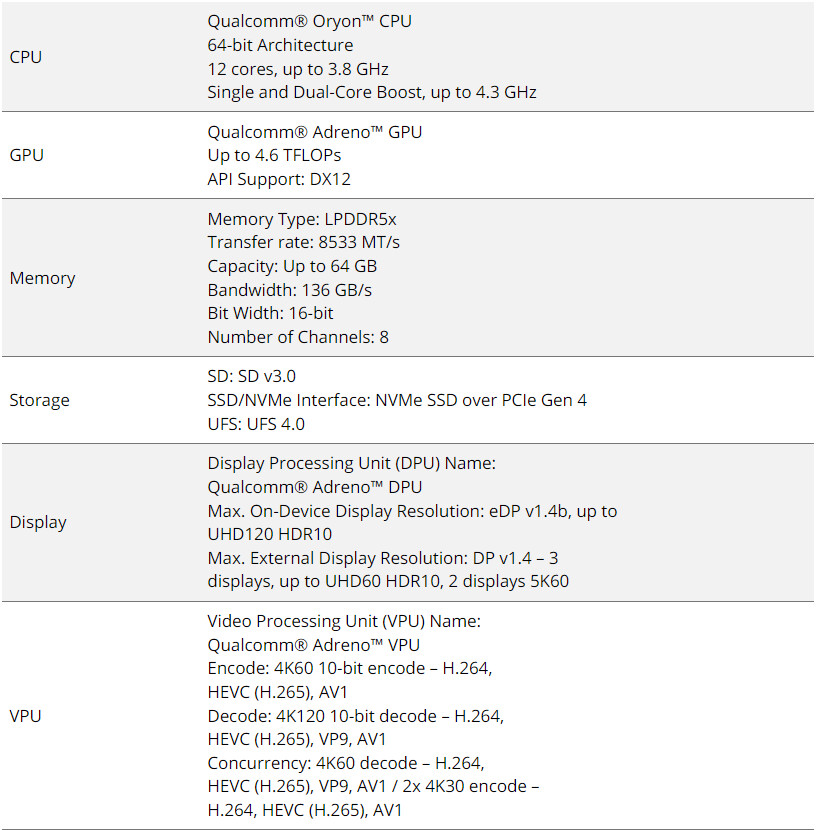
According to Windows Report, Qualcomm's upcoming Snapdragon Elite X chip for laptops has been revealed with several details. The chip is built on Nuvia-derived Oryon cores, with 12 cores in total. While the base frequencies are unknown, the all-core boost can reach 3.8 GHz, and the single and dual-core boosting can reach up to 4.3 GHz. It's important to note that the chip follows a pure "big" core configuration, without the big.LITTLE design.
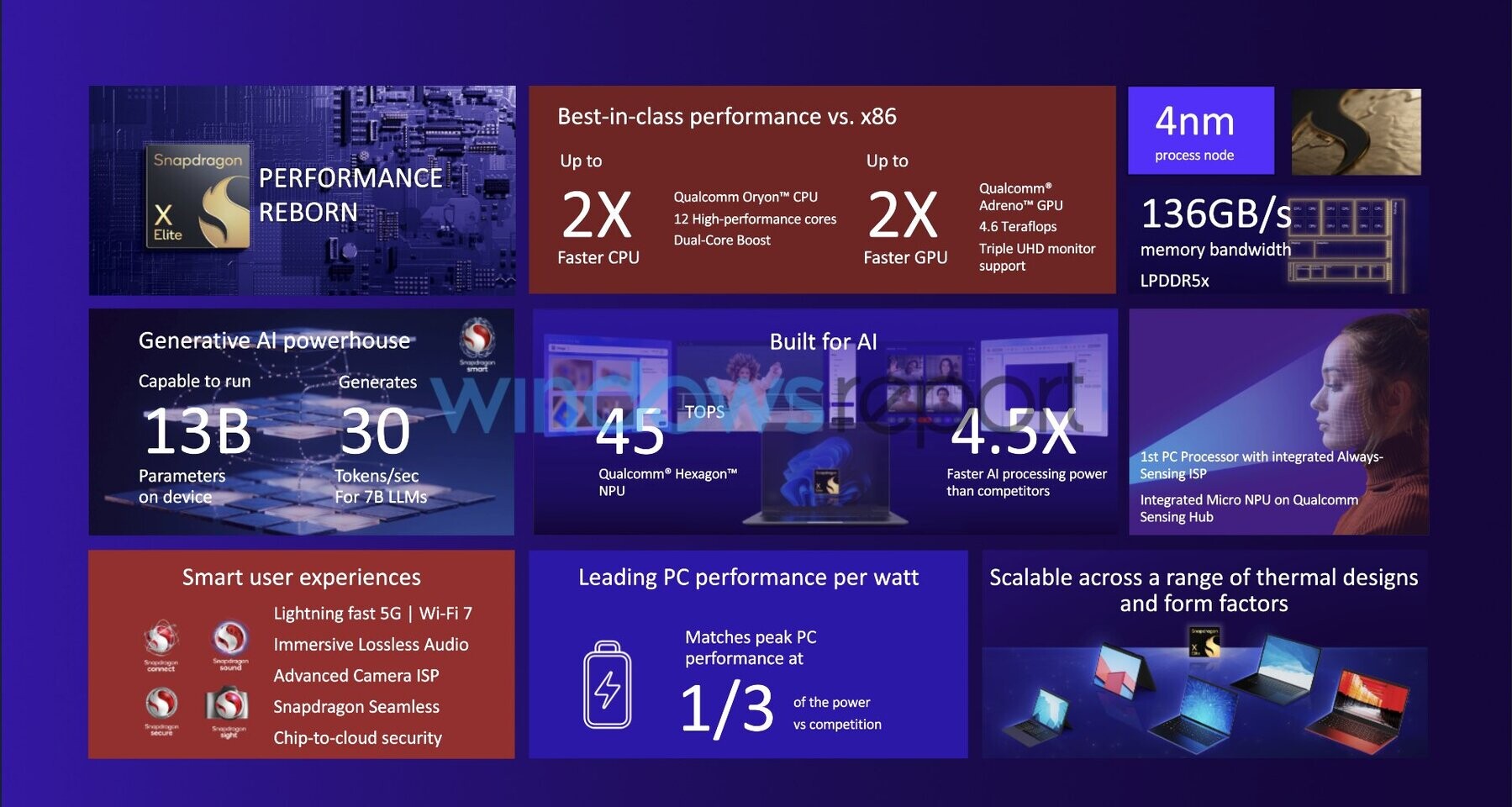
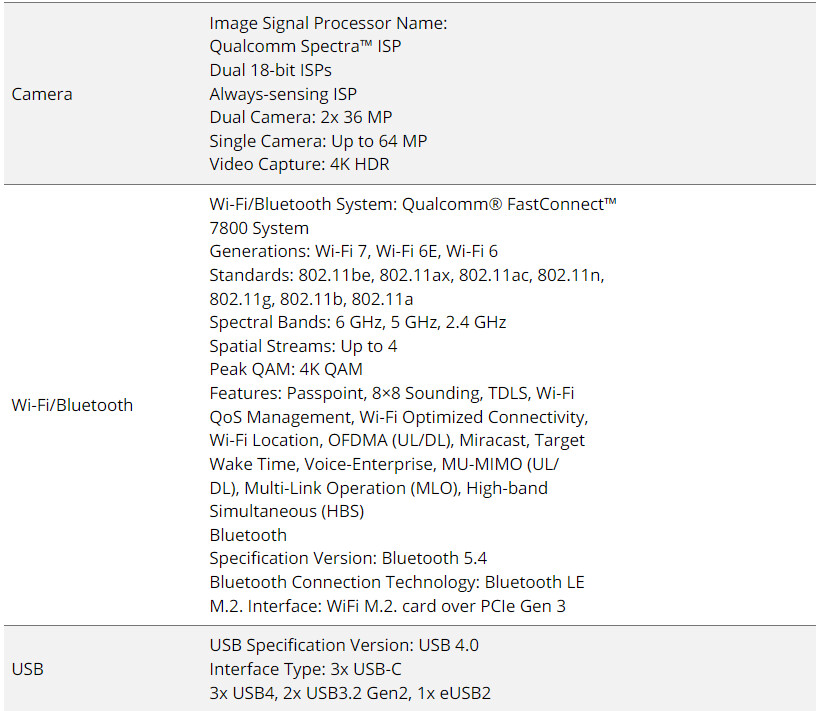
The GPU component of the Snapdragon Elite X is based on Qualcomm's Adreno IP, with significantly improved performance figures, reaching 4.6 TeraFLOPS of FP32 single-precision power. The chip also includes dedicated AI and image processing accelerators, such as the Hexagon Neural Processing Unit (NPU), capable of processing 45 trillion operations per second (TOPS). For camera capabilities, the Spectra Image Sensor Processor (ISP) supports up to 4K HDR video capture on a dual 36 MP or single 64 MP camera setup.
The Snapdragon Elite X chip supports LPDDR5X memory running at 8533 MT/s, with a maximum capacity of 64 GB. It features an 8-channel memory controller with a 16-bit width and a maximum bandwidth of 136 GB/s. The chip also supports PCIe 4.0 and UFS 4.0 for external connections. Manufactured by TSMC on a 4 nm node, the chip is marketed as both high-performance and power-efficient compared to x86 solutions.
In terms of connectivity, the Snapdragon Elite X chip supports WiFi7 and Bluetooth 5.4. It is set to be officially released in 2024 and will compete with Intel's Meteor Lake and/or Arrow Lake, as well as AMD Strix Point. However, there have been concerns about the integration of Qualcomm's own PMICs, designed for cell phones, which may cause compatibility and efficiency issues when deploying the new Snapdragon Elite X processor.
Qualcomm also highlights the chip's capability to run 13 billion-parameter models and 7B models at 70 tokens per second, making local LLM inference highly efficient. Official reviews are expected to be available next year for more information.
Below is the complete specification table, courtesy of Windows Report: